


Healing Power of Journalling
Journaling helps bring clarity to your thoughts
As counsellors, we've seen firsthand how journaling can be a transformative tool for improving mental health. Over the years, many of our clients have found it to be an effective way to manage stress, anxiety, and trauma. Whether you're new to journaling or a seasoned writer, the benefits for emotional well-being are profound. Here’s why journaling should be part of your mental health toolkit.

Love, Laughter and Emotion
Make Time for ‘Us’
Reconnecting as Parents: A Little Love, Laughter, Connection
Between doing the school pick-up, cooking dinner, tantrums, and endless loads of washing, it's easy to forget the one thing that brought you and your partner together in the first place — your relationship. But what if we told you that reconnecting doesn't need to be a big, complicated affair? You don't need to book a fancy weekend getaway or join a yoga retreat to rekindle the spark. In fact, a few small but powerful shifts can do wonders for your bond.
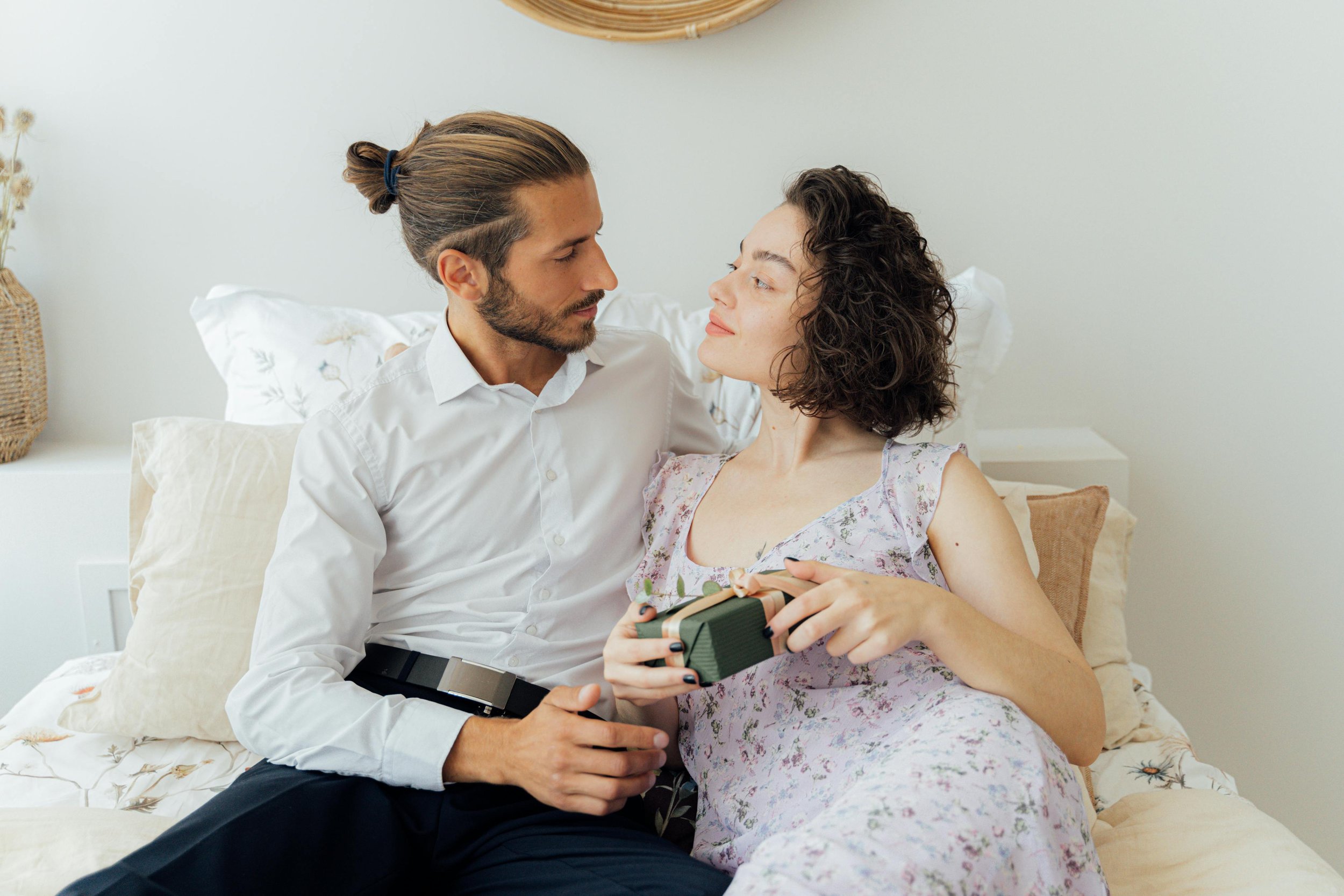
Reconnect with your partner: Eye gazing is powerful
I’ve seen how emotional disconnection can affect couples. Life’s stresses, routines, and conflicts often create distance between partners. However, there is a simple, powerful practice that can help restore that connection: eye gazing.
Eye gazing involves holding sustained eye contact with your partner. While it might feel uncomfortable at first, this practice has profound effects on emotional intimacy, trust, and empathy. It’s research based, and can be an effective way for couples to reconnect on a deeper level.

Investing in Relationship Checkups
When was your last relationship checkup?
Whether your relationship is strong or growing, like professional development, every relationship benefits from regular skill building.
I see many couples come in after years, sometimes decades of struggles with key issues such as resentment, unresolved conflict, intimacy disconnection, boredom, and loneliness. Which is why I focus on these key areas when couples book with me for a check up.

You are not broken: Hope for couples experiencing neurodiversity
Relationships are challenging, especially when one person in the relationship is on the autism spectrum (level 1 autism spectrum disorder ASD previously called Asperger syndrome). Misunderstandings, frustration, confusing and emotional disconnection may cause relationship dissatisfaction and fall-out.
Starved of physical affection, many neuro-typical (NT) women living in a long-term relationship with someone with undiagnosed ASD, express a common experience of loneliness, isolation and pent-up anger (Brown 2023). Lack of emotional intimacy and social connection may impact their sense of self and result in long-term emotional and mental health issues. Empowering women to live well in a neuro-diverse relationship and seek inner-happiness through education, setting realistic expectation and providing support structures, will improve self-esteem and mental health and will ultimately strengthen their neuro-diverse relationship.

Sensorimotor Art Therapy & Bilateral Guided Drawing
What is Bilateral Guided Drawing and how can it help me? Cornelia Elbrecht, Institute for Sensorimotor Art Therapy developed this evidence-based sensorimotor, somatic trauma therapy. Cornelia describes it as a "self-massage" but I also think of it as a Mental Health Massage. My clients usually end a session feeling "lighter" or "more relaxed" or "less-stressed."
A 'bottom-up' technique such as this, using body awareness, presence, movement, self-regulation, titration, self-understanding, and “active meditation”, releases and restores previously blocked natural rhythms. This kinaesthetic, mostly nonverbal approach empowers the client to help themselves by asking what does my body need, and thus finding an active response to a traumatic experience. You will be guided by your therapist, Robin, to scan your body for any discomfort or stress, and you then respond with what resonates with your internal body experience. There is no right or wrong' way of doing this and there are no rules. You do not have to have any artistic ability. Think of it as a mental health massage that reduces stress, discomfort and tension.

Volunteering Joy with NALAG Grief and Loss
What a pleasure it is to volunteer with NALAG the National Centre for Loss and Grief. I am honoured to provide support to grieving clients around Australia. Thank you NALAG for your gift today and thank you for showing your appreciation to me, one of your volunteers.
All of us experience grief and loss at some point in our lives, whether it's losing a loved one, losing our pet, or going through the anticipation of death with a loved one's journey with terminal cancer. Death, although common, is not something that most of us are comfortable with. We may find it difficult to sit with someone and hear their story but that's the very thing that will honour their loss and pain and will help them to move through the process of grief. Grief stories are stories of love. With much love, comes much pain.

Processing Grief Through Spirituality and Psychotherapy
Losing a loved one affects us physically, emotionally, and spiritually and our response is determined by the attachment bond we had to the deceased person. Processing grief through spiritual practices such as religious and cultural rituals or mindfulness, may assist in helping make sense of the experience, accept the loss, and move forward over time. For some people, loss may result in a deeper spiritual connection and for others, may cause them to question their spiritual beliefs, or even lose their sense of purpose. Spiritual practices that honour the bonds and attachments that contribute to our sense of identity and meaning in life will assist in processing grief.

An Affair—Betrayal Trauma
Betrayal trauma—anger and sadness may prompt you to begin ‘Detective’ work as you question everything after the discovery of an intruder in your romantic relationship. When trust has been broken through an affair it affects the very foundation of the relationship. It’s a violation of relationship trust and results in feelings of betrayal and abandonment. Healing is possible and takes courage to rebuild trust in the relationship. Couples Therapy can help you make sense of and provide a sense of safety when taking this difficult, courageous journey.

Losing Control Around Food
Do you eat large quantities of food in a short period of time, often feel out of control when eating meals and hide or steal food or feel shame around eating patterns? Do you have ‘black and white’ thinking or rigid rules around food and ascribe to the Diet Culture? Do you use food as a source of comfort or as a punishment? Do you have secretive behaviour around food? Do you want to be free of the out-of-control feelings you have around food? Do you want to be free from your food addiction? Mental clarity and peace of mind may elude you as you chase your food obsession.
Have you ever wondered if there is help for you? Your eating patterns are unique, they may have a genetic basis such as poor role models, or may be linked to personality traits such as perfectionism, low self-esteem or body dissatisfaction. If you experience an eating disorder it isn’t a lifestyle choice, it is serious and may potentially result in mental illness.

Do you try to control your close relationships?
Don't you hate it when people you're close to, (partner, siblings, best friend), won't be controlled? Do you sacrifice your own needs for others, and end up feeling resentful and taken advantage of? Are you taking on other people's responsibilities, trying to change someone by offering to help and take over when not asked? Do you 'Play God' in the lives of everyone around you, trying to control them, is a sign of co-dependency. "If I change him to do what I want, I'll be happy". Wrong! The only person you can change is yourself. The solution lies with you.

An affair doesn’t have to be the end of your relationship
"It feels like a bomb has gone off" is the feeling a person described after their partner disclosed an extramarital sexual affair. The fallout is devastating and the symptoms, such as hyper-vigilance and distress, are similar to post-traumatic stress disorder (Rokach & Chan, 2023, p. 13). It’s something you don’t plan for, could never imagine happening and it may feel like the relationship is over.
However I believe it’s something you can recover from if you’re willing to work through it.

Exploring and Expressing Grief
Grief is a process, not a straight line. I've recently been exploring different methods of processing grief. So I engaged my sister-in-law, Anita, Veritas Art Therapy, to help me work through grief. Nita writes, 'Art Psychotherapy is a visual mode of communicating which enables individuals to express things in new ways that go beyond words. Whether you see yourself as creative or not, Art Therapy offers a way to bypass our thinking and speech'. Expressing your emotion creatively allows to you sink deeply into your memories and thoughts for a moment in time, and really feel.
Everyone experiences grief uniquely. Getting in touch with our feelings is healthy. You have to express grief in ways that are meaningful for you.Through creative expression of our pain, we tap into deep feelings that can enhance our healing.

Peeling the Onion—Living Through Grief
Grief can be very painful. One lady I recently supported, described it as ‘intense pain in my heart…it hurts so much here…,' she said, pointing to her heart. Her husband died more than two years ago and the pain of missing him is still raw, intense and incredibly physical. Grief has a powerful effect on your body. Your immune and cardiovascular system changes and grief increases inflammation. Stephanie Hairston, WebMD writes, 'The heartbreak of grief can increase blood pressure and the risk of blood clots.
You may think grief is all about tears, crying and sadness and that you’ll be back to normal within a week or two after the funeral. But it’s not like that. Grief, like people is unique. Everyone goes through the experience at their own pace and in their own way. And it’s can’t be hurried. It needs to be unwrapped… felt… and dealt with little by little. It’s like the skin on an onion. Layer upon layer… you begin to peel it back, you cry a little, you cry a lot, you begin to unpack it and then...there’s more. Another memory, another flashback, another life. It’s not something you just ‘get over’.

Building Resilience
Everyone is talking about the buzz word 'Resilience' these days. I find it everywhere. But what does it mean and how do we apply it to our own life?
The three secrets of resilient people | Lucy Hone | TEDxChristchurch
https://www.youtube.com/watch?v=NWH8N-BvhAw
I came across this great TED Talk recently. I love TED Talks as they are real, succinct and often a true story of someone's struggle or experience. This story is a great story about hope that came from Dr Lucy Hone, a mother and resilience expert talking about suffering. Her 12 year daughter passed away suddenly and expectedly in a car accident. She had to make sense of this and incorporate what that meant for her. Traumatic events like this never seem to make sense. Her three secrets are real and have helped so many people already. I was challenged and I'm sure you will be too.

Emotional maturity is owning your own feelings
Practicing emotional maturity in difficult conversations, defuses conflict. “You make me so mad when you go out all the time!” Blaming statements like this may well result in a defensive response from your listener. I’m sure you’ve experienced this some time in your life and seen a negative result.
Be emotionally mature; turn this around by owning your feelings and using constructive communication.

Disability Doesn’t Stop Me
Sometimes I feel ‘less than, wrong or stupid’ are words I heard recently from a young woman on the spectrum trying to do life well.
Often people see the impairment not the person. Just because someone has a disability doesn’t mean they’re simple or stupid. Sometimes people just don’t know how to connect to someone with a disability, especially if you don’t have the communication skills needed to easily form relationships. It goes both ways.

Chasing Happiness…
’I feel so flat, now the holidays are over…back to the same old, same old’.... she had been up North for two weeks in sunny Queensland, and came to see me with pent up negative emotions about her house, job and living situation.
What was driving her reaction? A dissatisfaction with her current job and boyfriend or was she disgruntled with her life in general?

Communicating with people with disability is not hard
Starting conversations with people with disability is daunting. It’s not hard to start a conversation. You already know how to have a conversation with anyone and with a person with disability, it’s just a little different… Western Sydney University provides some useful tips and practical advice in this simple information sheet.
We all know communication is vital to developing and maintaining relationships effectively. When dealing with someone with disability, able-bodied people are perhaps at a disadvantage because we become uncomfortable with the silence and the long wait for an answer. It’s almost like, their disability turns back onto us.

Counsellor Insights—Buying Love, a Letter of Addiction
When confronted by life’s myriad traumas and complexities, we sometimes believe it impossible that anyone ever could truly understand us, or our situation, and especially about how we arrived at this place. And, all-the-while, we dream of escaping to somewhere better without the drama and angst, usually having absolutely no idea of where or even how to begin. All too often, we end up seeking solace from well-meaning, but poorly informed friends and family, craving their affirmation that we’re not wrong, not bad, and yet, never thinking to seek our own professional guidance and counselling so we can live life better.
As a professional counsellor, I can help you unravel the mess and trauma of life, and help you begin living your very best life.
“I’m happy to go where ever you recommend.” ... “[M]y question always is, what does he want me to change?”